Friday, 5 June 2015

Izzy's Learning Reflection

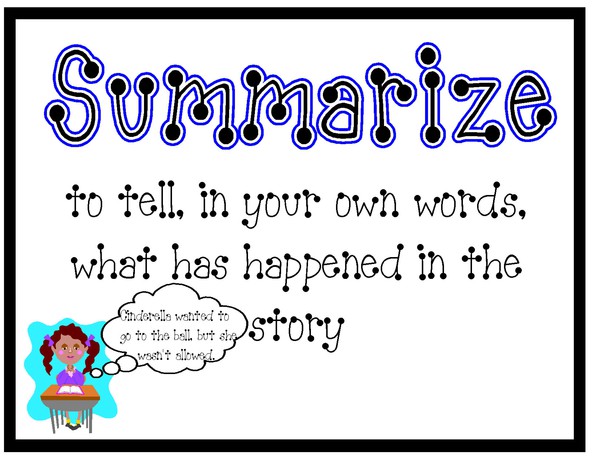
At the start of week one of my learning goals was summarising a text. But then Mr A held a little work shop on summarising and we learnt about how to summarise and it was great. 

We were reading a text about the weather machine and we had to find out what kind of batteries it needed. We learnt about only summarising the main ideas and not the back up ideas. Its really easy sucking out all the main ideas normally they are in the first sentence in a paragraph or mentioned twice or more. 

I persisted and then i got. It now summarising is very easy.

Tuesday, 2 June 2015

Writing Our Own W.I.T.s

This term we are doing things a bit differently. As part of our learning in Health and PE, we have selected an area of interest from our Health and P.E. brainstorm (scroll down). Some tasks are now ready and groups are starting tomorrow. The class have done fantastic - they have found that it is not so easy to write a learning task - lots of empathy for the teacher!

It is important to remember that it is the Learning to Learn skills and Cross Competency skills which are the areas we really want our students to develop through the W.I.T.s. These are the skills that help develop independent, life-long learners who can learn anything effectively!

I am very impressed by the standard of the tasks, the critical thinking gone into them and the open-mindedness displayed when I met with each group to discuss what they had written. Each group took feedback on board.

Here are some of the tasks:


Friday, 29 May 2015

Parent Newsletter Term 2 Week 7

IKAN goals

I did alright in my IKAN test, I could of got more done. But my brain my nervous!
I got 29/40 and i got more than last time but could of got more right.
My goals: Know the number of hundreds in numbers
Know some multiplication (7x 8x 9x 11x 12x)
learn subractions facts (speed)

Friday, 22 May 2015

Inferencing a text by Shanelle

Inferencing..............

When you inference its when the author doesn't say directly in the text but you piece what you already know with what the clues are in the text. Inferencing is when you use what your already know (e.g what you have done,read or seen before) with what the author has already explained in the text. Another part of Inferencing is predicting (predicting is when you think about whats going to happen next).


(e.g) - The guests went for second helpings,she could infer that they enjoyed their meal.


Thursday, 21 May 2015

Cooper's Explain Everything on Fractions

Ari's Explain Everything on Fraction Conversions

Health and P.E. in school

Today we talked a bit more about Health and P.E. and why we have it in schools. This is what it says in the NZ curriculum documents: "For students to learn how to take increasing responsibility for their own well-being and the well-being of others."

We talked about this and discussed what it means. Here are some responses:

 Isabelle says: For people to learn how to take more responsibility for their own health and the health of others.

 Briana and Shanelle say: It's our role to learn to take more and more responsibility for us being well and healthy and to help others that want help from us.

Ethan and Riley say: Want students to learn to take more and more responsibility for their own health and others health.

Abbie says: Taking more and more roles for your own health and others health

Jack says: For students to learn how to take increasing responsibility for their own well-being and the well-being of others.

What do you think it means?

How can you take more and more responsibility for your own health?

How can you help take more and more responsibility for others' health?
Sunday, 17 May 2015

Using the Te Ara Tika pathway in Maths

The Te Ara Tika Pathway helps us to learn anything - anything at all!

In  class we have brainstormed some questions related to learning about fractions. Here are the notes that Tia has made from her learning around the question of "What is a fraction and what do the numbers and symbols mean?" Wonderful learning!!!


And here is the Te Ara Tika pathway that led to that.

Term 2 Assembly Resources


Term 2 Week 5 Newsletter

Tuesday, 12 May 2015

Six Sentence Story...

Last week we started looking at how Narratives are written. We began by writing our 6 sentence story. Then we learnt that narratives have a set structure - usually a problem with a solution. Here is the format for writing a 6 sentence story.

Wednesday, 6 May 2015

Emily's post describing an addition strategy

Borrowing (Stealing) In Maths

Borrowing


You use borrowing by taking ones off of a number to make another number a Tidy Number. For E.G 
57+33=_  you take the 3 from 33 to make it 30. Then you add on the 3 that u took from 33 and add it onto 57 to make it 60. Adding with Tidy Numbers is very easy to do so you add 60+30=90. you do not give the 3 back so basically its stealing.

Borrowing can not be used with subtraction because the answer always end up wrong. For E.G 57-33=_ take 3 away from 33 and add it onto the 57 to make it 60. 60-30= 30. The real answer is 24. 

Borrowing should only be used with numbers that are close to a Tidy Number like the number 49. You need a number over 5 so its close to a tidy number.


Proofreading and Recrafting our Writing

Here is an excellent tool to help us recraft (make our writing better) and proofread (make our writing easier to read) our writing.


(This is taken from 'The Writing Book' by Sheena Cameron and Louise Dempsey)

Tuesday, 5 May 2015

Multiplying Tenths

Here is a video made by Shanelle on how to multiply tenths...there is quite a skill in making videos like this to teach others. Along the way, as good learners, we ask questions to help with thinking. One of the questions we posed was "How do you know that 4x8 tenths = 4.8? I can see you have used your basic facts but can you provide some evidence as to how it equals 4.8?"


Monday, 4 May 2015

Reflection and Feedback

Part of the learning process involves thinking about how we are going with our learning - reflection. We reflect on whether we are learning, what we are learning and what is making us successful or not.

Sometimes we give feedback to one another on this. After receiving some feedback Kyle decided to change his learning video on Algorithms - he has improved it to make the message a bit clearer. Well done Kyle. Here is the new and improved "Algorithms 2.0".